After confirming it with more than one company lifer, December 2025 is indeed the busiest month ever in Perodua’s history. Never before had the perennial market leader introduce two all-new products in one month, but such a schedule wasn’t on the bingo card of Perodua, which plans things meticulously and sticks to it.
The QV-E, Malaysia’s first homegrown EV, was launched on December 1, and just over two weeks later, here we are with the official unveiling of the Perodua Traz, a B-segment SUV that’s been long in the making. Yes, Traz is the name (not Nexis), and there are two variants – the X at RM76,100 and H at RM82,000, on-the-road without insurance. No AV, but more on that later.
Interestingly, both December babies came to life in very different circumstances – if the EV was ‘national service’ in adherence to the government’s wishes, the Traz a.k.a. D66B has been rumoured for what seemed like ages. Indeed, P2 said that the D66B project started in May 2021!
The great delay

Yes, May 2021, which makes it just a few months short of five years. It’s no secret that the Traz is a rebadged Toyota Yaris Cross, which debuted in June 2023 in Indonesia and October 2023 in Thailand. Perodua is two years late, and president/CEO Datuk Seri Zainal Abidin Ahmad put his hands up (figuratively) at last week’s media preview to acknowledge the delay.
Like the supercharged development process of the QV-E, the Traz’s long gestation period is also uncharacteristic of Perodua. Zainal and management cited Daihatsu’s ‘procedural irregularities’ safety testing scandal that surfaced in late 2023 as the reason for the delay. This is P2’s fourth model to be based on the DNGA platform after the Ativa (2021), Alza (2022) and Axia (2023).
The P2 chief also openly admitted that the Traz’s age means that it brings nothing new to the B-SUV table – perhaps that’s why they chose ‘Engineered Simplicity’ as the car’s USP/theme. Before you laugh, I’m sure there are many who look for simplicity, practicality and reliability in a car – after all a car like this is meant to be a tool, and there’s a reason why Toyota is the world’s top carmaker despite rarely pushing boundaries.

Before we move on to the car itself, the Traz name is linked to the Malay word teras, which means core. Perodua says that this model embodies the core values of the brand – think simplicity, efficiency, practicality and reliability. This ties in with the ‘simplicity’ theme chosen for the launch. Coincidentally, Traz also sounds like trust, and this trusted brand will soon complete two decades as Malaysia’s market leader after usurping Proton in 2006.
Yaris Cross twin, not an Ativa replacement
At 4,310 mm long and 1,770 mm wide (figures that are identical to the ASEAN Yaris Cross; Japan and Europe get a separate and smaller model), the Traz is 245 mm longer and 60 mm wider than the Ativa, while its 2,620 mm wheelbase is 95 mm longer than the compact SUV.
Compared to B-segment rival Proton X50, the Traz/Yaris Cross has a slightly smaller footprint (70 mm shorter, 25 mm narrower) but compares very well in wheelbase length (20 mm longer). The ground clearance is pretty high at 210 mm, 10 mm more than the Ativa and 14 mm higher than the X50.
These dimensions put the Traz in between the Ativa and the much-larger (and also much less sophisticated) Aruz in Perodua’s lineup. The company says that it’s targeting mid-income married men with less than three kids as the Traz’s main buyer, one who’s upgrading from a compact car. This would be Mr Provider’s main car, serving every function from daily transport to balik kampung trips.


The Traz will do very well on a road trip thanks to a generously-sized 471-litre boot, and that’s with a full-sized spare steel wheel with the same Toyo tyre. For context, this is over 100L more than the Ativa and 141 litres bigger than the Proton X50’s cargo bay, and it can take in up to six trolley bags, or four if two of them are large ones. It’s good news that the bay is shielded by a conventional retractable tonneau cover.
What about the Ativa? The Traz is not meant to be a replacement of that car. The Ativa is smaller (and therefore not as good a family car as this), but it’s also better equipped (yup, more on this later) and has a more advanced turbocharged powertrain. The Ativa will continue for now, aimed at younger folks or those without family considerations. The Traz’s interior space advantage is substantial though, which gives buyers a decision to make.
Simple and sensible
As such, this writer suspects that the Traz won’t be seen as much of an upgrade to current Ativa owners, but those coming from a Myvi G3 would be happier – familiar elements (1.5L CVT) are coupled with a stylish SUV body and added space/practicality for a growing family.

The Traz is powered by the 2NR-VE 1.5L engine, which is a bedrock of the Toyota group in our region, with millions of units powering cars of various shapes and sizes. Perodua has been using this DOHC, Dual VVT-i naturally aspirated four-pot in the Myvi since the third-generation surfaced in November 2017.
Initially, the 2NR was paired to a four-speed auto, but the Myvi’s November 2021 facelift onboarded the D-CVT (Dual-Mode CVT) for improved performance and fuel economy. The current Toyota Vios and Alza also use this powertrain combo.
The 2NR puts out 106 PS at 6,000 rpm and 138 Nm of torque at 4,200 rpm. The fuel tank size is 42 litres and Perodua quotes fuel consumption of 21.3 km/l in the Malaysian Driving Cycle (MDC). If MDC rings a bell, Proton recently used it for the new Saga MC3’s FC, which is 20.4 km/l with the new 1.5L i-GT NA/Punch CVT combo – that’s right, the Traz, a much bigger SUV, is more fuel efficient than an A-segment economy car. And the smaller Ativa, too. By the way, there’s no Eco Idle auto start-stop here, so there’s no need for a more expensive EFB battery.


Much of the efficiency is contributed by D-CVT, the world’s first split gear CVT system. Basically, the unit combines belt drive with a gear drive for improved fuel efficiency, acceleration feel and quietness. From rest to low/medium speeds, the D-CVT functions like any other CVT, with the engine’s torque going through a torque converter (like Toyota and Honda CVTs; Proton’s Punch CVT uses a clutch pack) and into the input pulley, before being transferred to the output pulley via a belt and then to the wheels.
At higher speeds, the D-CVT shifts into its split mode, engaging the gear drive to provide more efficient power transmission (less energy loss), while the rotation to the belt drive is decreased significantly. There gearbox has a manual mode with seven virtual ratios – as per the Ativa – plus Eco, Normal and Sport drive modes.
The efficient hardware isn’t bogged down by weight. It has a five-star ASEAN NCAP rating and a longer wheelbase than the HR-V and X50, but the Traz tips the scales at just 1,150 kg for the top spec H. The lightest X50 is 201 kg heavier (how many adults is that?) while the base HR-V S (also a 1.5L NA CVT) is 124 kg heavier.


Unfortunately, the Traz doesn’t get the Yaris Cross’ hybrid option, which is available in Indonesia (NA and HEV) and Thailand (HEV-only). Guess we’ll have to wait for the actual T-badged Yaris Cross for the electrified powertrain.
No hybrid, no AV
If the unavailability of the hybrid to accommodate big brother’s own version of the car is understandable (we noticed that this is the first joint model that does not have a Daihatsu-badged equivalent), the lack of an AV variant is conspicuous. The Traz has base X and mid H variants, and that’s it.
The X comes with automatic LED headlamps with follow me home and manual levelling, LED positioning lamps, LED tail lamps and auto retractable side mirrors with LED turn signals. The wheels are 17-inch two-tone alloys with 215/60 Toyo Proxes CR1 tyres. Behind those branch-like spokes are all-round disc brakes, required for the electronic parking brake with auto hold function.


Inside, those coming from DNGA AV variants will be surprised to find an analogue twin-dial meter panel with a 4.2-inch multi-info display (all very classy and clear, thankfully), instead of the usual full-digital affair. It’s an all-black theme for the cabin (with black headlining too), and there’s plenty of red highlights, especially on the dashboard, which has red stitching plus gloss red trim pieces.
The fabric seats have red stitching and a graphic on the top portion. The design sees a red spine dividing grey and black areas. It’s quite sporty, and the design is extended to the seat base in the H. The rear seats have a fold-down centre armrest with cupholders and rear air con vents, which is a first for a non-MPV Perodua.
The 9.0-inch head unit is a Perodua item with wired Apple CarPlay and Android Auto, linked to four speakers. There are two USB ports in front (1x A, 1x C) and two at the back (2x C) plus one 12V socket in the centre armrest cubby. There’s a push start button, but note that the X does not come with keyless entry – that’s reserved for the H, which has touch sensors on both front doors instead of the usual P2 driver’s door-only rule. Ini Toyota ma.


Other new-to-Perodua features (QV-E excluded) are telescopic steering adjustment and illuminated vanity mirrors in the (solid feeling) sunshades. Speaking of elements that are not from the Perodua parts bin, check out the air con control panels – button-only in the X and two-knob single-zone automatic in the H. The lone empty button would have been for the front demister, which is not available on this model, regardless of marque.
So, no M1-M2 air con memory function here, which I’d miss, but Perodua managed to add on its dedicated lock/unlock button, albeit in an unusual location to the right of the AC panel. This slot hosts the PM2.5 filtration button in the Thai Yaris Cross, which we don’t get. Finally, there’s solar and security window tint included, and Perodua uses a big brand in Llumar.
Going for the H will net you LED front fog lamps, welcome lamps at the side mirrors, and the H mark on the tailgate. Crucially, the H comes with the above-mentioned keyless entry (two front doors) along with leather on the steering and gear knob, auto air con and two tweeters (for six speakers in total). There’s also a 360-degree parking camera and dashcam, but the powered tailgate with kick motion sensor is definitely the headlining act.
As to the conspicuous absence of an AV range topper, a Perodua rep said that a ‘Traz AV’ would potentially be priced around the RM90k mark set by the CBU Nautica in 2008, and that could be too high to be competitive in current market conditions. There’s some point in that, and also the gap to UMW Toyota Motor’s Yaris Cross to be mindful of.
Safety basics covered, no ACC


Safety wise, this ASEAN NCAP five-star-rated car comes standard with six airbags, Perodua’s ASA safety suite with pre-collision warning and brake (AEB, for pedestrians too), front departure alert and pedal misoperation control. There’s also lane departure warning/prevention and blind spot monitoring.
Parking assists come in the form of rear cross traffic alert and front/rear corner sensors. The Traz kit list might have raised some eyebrows, but P2 deserves praise for not compromising on safety kit – the X gets all of the above and nothing crucial is reserved for the top-spec car.
What’s exclusive to the H are the 360-degree parking camera (reverse camera for the X) and dashcam. Noticed something missing? The Traz does not come with adaptive cruise control (ACC) – or even regular cruise control for that matter – which is why its right steering spoke doesn’t have a D-pad. Might sound silly, but although I rarely use ACC in my Perodua, I like the ‘full function’ look of the steering wheel – it’s a bit empty here.
For context, in the 2025 Proton X50 facelift, you’ll have to opt for the RM101,800 Premium (previously Flagship only) to get AEB, which comes with the full ADAS pack.
Differences from the Yaris Cross

The Traz is the first of the twins to surface, with the Yaris Cross coming soon from UMWT. It’s expected that the Toyota will feature a hybrid powertrain, which is the sole option in Thailand, and sold alongside the 1.5L NA in Indonesia. This Toyota system (not to be confused with Daihatsu’s e-Smart system found in the Rocky Hybrid) combines a 2NR-VEX 1.5L NA Atkinson-cycle engine (91 PS/121 Nm) with an e-motor rated at 80 PS/141 Nm, juiced by a lithium-ion battery.
The hybrid powertrain will be a substantial differentiator between the Yaris Cross and the Traz. Previous shared models like the Aruz-Rush and Alza-Veloz were separated only by cosmetics and kit. Speaking of kit, there should be clear air between the two as Perodua is a bit restricted in this area, with no room for a range-topping AV even.
Should UMWT’s Yaris Cross mirror the Thai-spec car, extra kit over the Traz could include roof rails, 18-inch wheels, Toyota’s own touchscreen head unit, blue stitching across the cabin (instead of red), a digital instrument panel, ACC and its controls on the right steering spoke, powered seats, wireless charging pad and a panoramic roof. Hankering for a ‘Traz AV’? There’s one coming soon, just not from Perodua. Expect to pay over RM100k for the all the extras.
Gearing up your first SUV


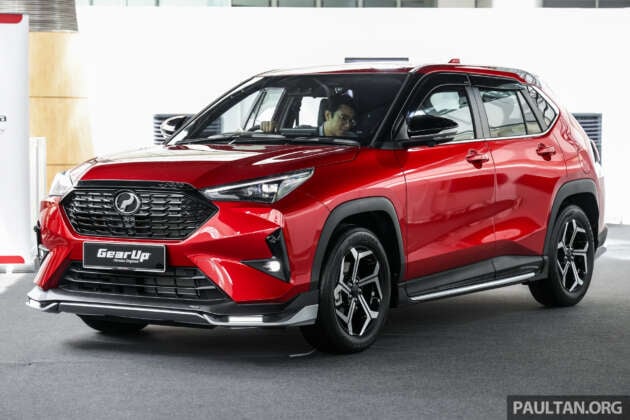
The red car you see here is the H with a full catalogue of GearUp accessories, which are available from launch. As usual, P2 has created bundles, and they are the Sleek Bodykit, Elevate Package, Illumination Package and Utility Package. The first one is self explanatory – it’s a RM2,700 four-piece bodykit (front, rear, side skirts) with LED DRLs on the front lip.
The middle rear spoiler is part of the RM900 Elevate Package, which also includes a front grille garnish and side mirror covers. The front grill garnish is basically a gloss black trim (all items in this pack are gloss black) on the top of the grille that ‘completes’ the hexagon outline. It has a ‘songket-inspired’ motif that’s repeated on the wing mirror covers and other GearUp items in the cabin.
The RM580 Illumination Package consists of RGB (red, green, blue) floor lighting and scuff plates – you can toggle through the colours by pressing the ‘RGB Light’ button next to the head lamp leveller. There’s also a mode that auto-cycles the colours, but please don’t. The RM510 Utility Package buys you window visors, a luggage tray and coil mats.


Some of these items can be ordered à la carte along with stuff like the ‘Nappa Leatherette’ seat covers for those who really don’t like fabric (RM1,200), wireless charger (RM350) and hood insulator (RM110). Instead of coil mats, GearUp’s Trapo-style car mats (RM300) are safer and more practical. Add all of these up and you’re looking at over RM6,000 of accessories, making the Traz H you see here a RM90k car. But can masuk loan la.
Finally, colours. Options include Cranberry Red, Ivory White, Glittering Silver and Granite Grey. The H gets a two-tone option, and you can pair the black roof with Glittering Silver or Electric Blue. The latter is exclusive to the H and only comes in two-tone.
Simplicity, the Toyota way
So there you go, the long-awaited Perodua Traz, which might be more conventional (proven 1.5L NA CVT combo) and less groundbreaking (no big tech debut such as the hybrid) than some would have expected. But even before accusations of Perodua of playing it too safe and offering nothing new to the segment come flying in, Rawang is pre-empting by calling the Traz ‘pure simplicity’ and its ‘most user-friendly vehicle to date’.

It almost sounds like self-deprecating humour, but in truth, there is a big market for reliable no-frills products – the Toyota Corolla Cross‘ ubiquity despite almost every B/C SUV being more stylish/better equipped/’better value’ than it is proof. The Proton S70 is a good case in point – armed with turbo-DCT power, ‘C-segment’ claims and big screens, but priced to match the Vios/City, it was tipped to blow away the T&H duo by netizens and the baik beli crowd. Remember that? Now check out the sales chart.
With the Traz, there’s no fancy big screen to go blank, and there’s no current powertrain in ASEAN that’s more proven than the good ol’ NR. Sure, it won’t be for everyone (not this Ativa owner, for one), but this is also accounted for in a modest (by Perodua standards) sales target of 1,900 units a month, of which 76% of this ‘unique market niche’ are expected to come from the pricier H. A rebadged Yaris Cross it may be, but the Traz is a RM563 million project built at the PSSB plant in Sg Choh with 95% local content, a level typical of P2’s ICE cars.
Again, the new Perodua Traz is priced at RM76,100 for the X and RM82,000 for the H, on-the-road excluding insurance. The factory warranty is the usual five years or 150,000 km. Spec-for-spec, this is around RM14k more than the Ativa, and the gap is more if you factor in year-end rebates for the smaller SUV. Browse the gallery and watch the walk-around video below and tell us what you think.
GALLERY: Perodua Traz X


GALLERY: Perodua Traz H with GearUp package


The post 2026 Perodua Traz launched in Malaysia – Toyota Yaris Cross B-SUV twin, 1.5L NA CVT, X/H variants, fr RM76k appeared first on Paul Tan’s Automotive News.