
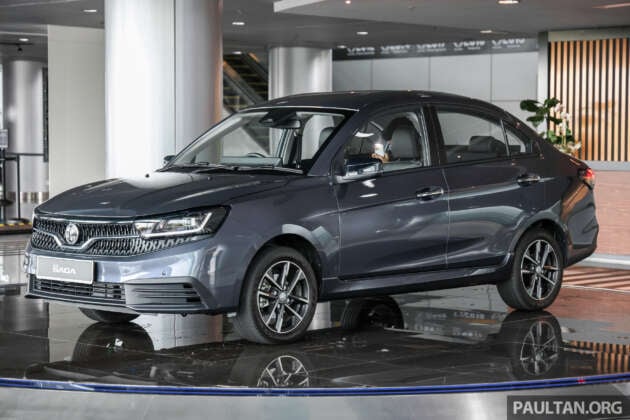
At long last, after months of spyshots, leaks, teasers and previews, the new Proton Saga has been launched in Malaysia – just in time to celebrate its nameplate’s 40th anniversary. We already know everything that’s new about the evergreen budget sedan, from its revitalised design to the all-new engine and controversial transmission choice, but now we finally get to know the price as it officially goes on sale.
It goes without saying that the Saga is a hugely important new product, not just within the historical context (first Proton model, over 2.1 million units sold), but also the fact that it competes with Perodua’s top-selling model. Building a (mostly) successful line of SUVs is one thing, but if the national carmaker really wants to be Malaysia’s #1 car brand, it will by definition have to steal sales from the current top dog at some point.
Where better than from the Bezza, which sold over 100,000 units last year, making up nearly a third of all Perodua sales, compared to the less than 70,000 Sagas that left dealer lots. With this new model, Proton has a car that is claimed to be at last almost as frugal, all while being much more powerful and offering a higher level of kit and technology – and it has already secured 20,000 bookings for it. Let’s take a closer look.
Prices slightly lower than expected, from RM37,990

Let’s get straight to the most important part. The new Saga is available in Standard, Executive and Premium versions, streamlining the rather confusing previous lineup that consisted of the Standard M/T, Standard Lite A/T, Standard A/T, Premium A/T and Premium S A/T.
Prices start from RM38,990 for the Standard, rising up to RM44,990 for the Executive and RM49,990 for the Premium. Proton is also offering an RM1,000 rebate for early-bird buyers, valid until the end of the year. With this, the official pricing is as follows:
- Proton Saga 1.5 Standard A/T – RM37,990
- Proton Saga 1.5 Executive A/T – RM43,990
- Proton Saga 1.5 Premium CVT – RM48,990
All figures are on-the-road without insurance, inclusive of the usual five-year/150,000 km warranty and free labour for the first three service intervals. The Saga was estimated to retail from RM40,000 to RM50,000, and if you were one of the over 10,000 people that pre-ordered one before today, you will receive a special edition Touch ‘n Go card and a full year of free service (including parts and labour).

These go on top of a launch package that includes either RM1,500 in additional trade-in value or RM2,000 for traded-in vehicles older than 15 years. There’s also financing interest rates from as low as 2.6% per annum and an upgraded insurance programme with special perils coverage, up to RM2,000 in upgraded flood relief and personal accident coverage for passengers at up to RM1,500 per person. Again, these are only valid until December 31 this year.
By comparison, the outgoing model started at RM34,800 for the Standard M/T, rising up to RM38,300 for the Standard Lite A/T, RM38,800 for the Standard A/T, RM41,800 for the Premium A/T and RM44,800 for the Premium S A/T. We should point out, however, that Proton has discontinued both the Standard Lite and the manual transmission (rest in peace) with this new model, which at least partly explains the jump in starting price. The national carmaker also claims buyers of the new car get up to RM12,000 worth of extra kit.
How does this compare to the Bezza? Well, that car’s entirely automatic range is priced at RM36,580 for the 1.0 G, RM43,980 for the 1.3 X and RM49,980 for the 1.3 AV. Keep in mind that the base model offers only a 1.0 litre three-cylinder engine from the Axia, whereas the Saga comes as standard with a 1.5 litre mill.
Revised AMA platform set to spawn new Saga variants

As we discussed previously, the new Saga is effectively a heavy facelift of the third-generation model. Proton may market this car as the all-new, fourth-generation Saga, but the car is internally referred to as the Minor Change 3 (MC3) of the third-gen 2016 model, and you can even spot this tag on stickers on some of the components. In fact, you can trace the car’s lineage all the way back to the second-gen Base Line Model (BLM) Saga from 2008 – itself derived from the Savvy hatchback from 2005.
Nevertheless, the Saga has received a substantial reengineering job to accept new technologies and safety equipment. The platform is now dubbed the Advanced Modular Architecture (AMA); it can be stretched or chopped to suit the car being developed (hence the “modular” in its name), and it also incorporates a brand-new electrical architecture. More on that later.
Additionally, the structure has been strengthened using hot-press-formed (HPF) steel B-pillars and floor cross member, along with an advanced-high-strength steel roof cross member and high-strength steel door bars. This has enabled the Saga to maintain its four-star ASEAN NCAP safety rating, despite being tested on a protocol that is two generations newer (and stricter), on the final year of the 2021-2025 protocol. The changes have made the body so much stiffer that the new model is able to do away with the old car’s strut brace.

Handling, a key Proton strength, has been improved through a redesigned cross member and stiffer bushings on the rear subframe, as well as a new anti-roll bar, also with stiffer bushings. The new Saga also rides slightly higher than before to protect the new engine, which sits lower in the engine bay. Also upgraded is the power steering, going from hydraulic to electric assistance.
Proton claims that AMA is “flexible, scalable and future-ready” and is designed to meet international safety, performance and efficiency standards. It adds that it owns the full intellectual property rights for the platform, reinforcing its “growing engineering capability.”

The company is open to collaboration across the Geely Group, it says, “potentially positioning Malaysia as a regional engineering hub for future model development.” Again, this begs the question – could we see Proton-based Geely models instead of the other way around?
Since the initial preview, it’s been rumoured that the Saga will spawn several new body style variants, including a hatchback, an MPV and even an SUV. To this writer, it’s more likely that Proton will create a Saga sub-brand for its range of indigenously-designed models to cash in on the sedan’s continued success, retaining the AMA platform and powertrain but being otherwise unrelated. We’ll see which idea prevails.
And speaking of the powertrain…
Goodbye CamPro, hello all-new 1.5 litre BHE15PFI four-cylinder

We’ve talked about this at length several times before, but we’ll say it again – the new Saga marks the demise of Proton’s long-serving, in-house-developed CamPro engine family. In its place sits an all-new, Geely-derived 1.5 litre BHE15 four-cylinder engine that we first saw in turbocharged form in the facelifted X50, here in BHE15PFI guise with natural aspiration and port fuel injection.
The BHE15PFI was introduced on the plug-in hybrid Geely Galaxy Starship 7/Starray EM-i/EX5 EM-i, which itself is set to becoming the Proton eMas 7 PHEV, with camouflaged test prototypes already roaming our roads. In pure petrol form, however – burdened with the need to drive the wheels alone, rather than being augmented with electrical power – it has been retuned for more power and torque.
This high-output BHE15-CFN tune is very new, having only been added to the Chinese market’s Geely Emgrand (known to you and me as the Proton S70) this year to replace the direct-injected BHE15-AFD. This is presumably to cut down on carbon deposits and reduce maintenance – a key consideration for budget-friendly models like the Emgrand and Saga.

Benefitting from new technologies – and a sizeable increase in swept volume, up from the old 1.3 litre mill – the new Saga gets a big boost in outputs, now producing 120 PS at 6,100 rpm and 150 Nm of torque between 4,000 and 5,000 rpm. That’s 25 PS and 30 Nm up over the outgoing model, and a similar margin over its arch nemesis, the Bezza 1.3 (95 PS and 121 Nm). In fact, the new car damn near matches the Honda City‘s 1.5 litre i-VTEC engine in power (121 PS) and beats it in torque (145 Nm).
Proton claims the new engine not only delivers more power than before, but also reduces the Saga’s fuel consumption by up to 14.04%, thanks to it running on an Atkinson cycle – something usually reserved for hybrid vehicles. Further helping its cause is the fitment of dual variable valve timing (DVVT) and an electric water pump, while a dual-mass flywheel cuts vibration and noise, the latter by up to 25.24%.
Last but not least is news that will be music to the ears of those who frequent our comments. Yes, the Saga will finally come with a timing chain instead of a belt, reducing the maintenance needed. It’s also a toothed chain, cutting down on NVH versus a regular roller chain. Proton says the new engine has racked up a total of 9,000,000 km of global testing mileage and over 50,000 hours of dyno testing to ensure reliability.
Aisin 4A/T or Punch CVT, 4.9 litres per 100 km fuel consumption

Much has been made about the transmission choice for the Saga. Again, there’s no longer a manual version (still a shame, especially given the relatively strong engine outputs), and the Standard and Executive models use the same Aisin-sourced four-speed automatic as before.
The Premium, on the other hand, goes back in time to the Punch VT3+ clutch-based CVT – the very same one Proton ditched in 2019 in favour of a slush ‘box. It will likely have been retuned for the application and incorporate learnings from the newer Iriz and Persona to further optimise response and reliability.

Despite the stepless transmission’s reputation for being inefficient, it’s actually the Premium that saves the most fuel, with a combined consumption figure of 4.9 litres per 100 km on the Malaysian Driving Cycle (MDC) – achieving the aforementioned 14.04% improvement.
That compares well with the auto’s 5.1 litres per 100 km (10.53% lower than before) and even the Bezza 1.3’s 4.8 litres per 100 km (without Eco Idle start/stop, which most people turn off anyway) – despite the Saga offering significantly more power and torque. It should travel further on a tank, too, thanks to it having a larger 40 litre fuel tank versus the Perodua’s 36.
The choice to return to a CVT – and a Punch unit as well – is a bizarre choice, not just given Proton’s turbulent history with the transmission, but also Geely’s own drivetrain strategy. In China, the Emgrand uses a more modern CVT with a simulated eight-speed mode, while in other markets, the direct-injected mill (with similar outputs, let’s not forget) is paired with a six-speed automatic. Why not here, too?
Heavy facelift with all-new front end, LED lighting standard

By now you will have seen the new Saga from all angles – and made your mind up about that polarising front end. The massive grille, likely needed to cool the new engine and featuring pins said to be inspired by songket embroidery, spans the entire front end and envelops the headlights. This leads to a face that appears to be about two sizes too big for this tiny car.
No matter what you think of this new design, however, you’ll have to admit that it is, at the very least, fairly modern. The now full-LED headlights feature rectangular projectors for low and high beam and a cascade of indicators – and just like the Bezza, these are standard across the range. As an added bonus, the projectors can be seen as an upgrade on the X50, X70 and X90, and of course the Bezza – all of which use reflectors.
What aren’t standard are the L-shaped LED daytime running lights that lead neatly to the chrome Ethereal Bow grille bar. With the deletion of the bumper-mounted DRLs, the air intakes now look fairly plain, entirely finished in black plastic; they have also been made slimmer to fit the larger grille.


The bonnet is also new, with a taller and wider central bulge for “an expression of power,” says Proton. This plus the myriad front fender changes have necessitated a mild re-profiling of the front fenders, with bonnet shutlines that drop down towards the front for a sleeker appearance.
Along the side, one can clearly see that the cabin section and rear fenders are visually unchanged from the previous Saga. This is borne out by the dimensions, retaining the 2,465 mm wheelbase and width of 1,690 mm – although the new car is 55 mm longer at 4,390 mm.
Eagle-eyed viewers will be able to spot the chrome strips on the door handles that aim to provide a classier look, as well as the gloss black “aerodynamic” door mirror caps from the Lotus Evora 400, featuring a protruding leading edge for greater shape. There’s also a new shark fin aerial that replaces the old bee-sting unit, oddly also finished in gloss black.

The Premium loses the bodykit and red accents that were offered on the old Premium S, but it does get side skirts (of a different design) that provide a fuller look versus the other variants. Also exclusive to the Premium is a matte black finish for the B-pillars.
The rear end sees another wholesale change, with LED taillights joined together by a central bar with the Proton script, providing a familial resemblance to the larger S70. Diagonal segments perform the main lighting function, joined by indicator strips at the top and the brake and reverse lamps at the bottom. Unfortunately, the third brake light continue to use a slower-reacting bulb, which isn’t good for safety.
On the Premium, these taillights are joined together by an illuminated strip, which also houses an external boot lid release. The other variants don’t have this luxury, which not only leads to a disjointed look but also means you’ll either have to press a key fob button or pull a lever on the inside to open the boot.


The “aero” boot lid itself rises slightly higher than before, negating the need for a separate lip spoiler as before. The rear bumper contains a simple diffuser-like black valance and dispenses with the old car’s slightly ostentatious fake corner vents. As for badging, the Saga script uses a more angular typeface that harks back to the original, and there’s also an “i-GT” badge to denote the new Intelligent Green Technology engine.
Colour options include the returning Ruby Red, Armour Silver and Snow White, plus two new ones – Marine Blue from the X90 and Space Grey from the pre-facelift X70. As for the wheels, the Standard model receive the same 14-inch silver alloys wheels as before, while the Executive and Premium gain new 15-inch “Arrow” eight-spoke rollers wrapped in 185/55 R15 Atlas AS380 tyres; the Premium adds a two-tone finish.
New interior, twin displays, wireless Apple CarPlay and Android Auto

A similarly comprehensive makeover has occurred on the inside, where you’ll find a new dashboard with a modern horizontal design, a beach-inspired wavy pattern on the decor, pill-shaped air vents said to be inspired by congkak boards and returning fake stitching – all rendered in hard plastic, as is typical for this price range. Of course, your eyes will be drawn to the widescreen display panel that houses two screens, including a digital instrument display for the first time.
The seven-inch unit is fitted even to the base model and comes with two display options – a “traditional” theme with two (oddly unmarked) analogue dials for revs and speed, and “digital” with a minimised rev counter bar and an instant fuel consumption readout. Users can adjust various settings such as the overspeed warning and trip computer reset, all using the new flat-bottomed steering wheel from the X50.
On the left is a nine-inch infotainment touchscreen on the Executive and Premium models, running on on a simplified version of the Atlas operating system – still with a media player, Bluetooth connectivity and a “Hi Proton” voice control system. Despite being marketed to a wider audience, the Saga loses out on its sibling’s new Bahasa Malaysia option for the menus and voice control (despite the instrument display being available in BM), making do with just English.


Better news is the fact that wireless Apple CarPlay and Android Auto will be made available from launch, making the new Saga the first A-segment car to offer this feature. There’s no denying that this display setup has thoroughly modernised the car’s cabin, even if the large bezels necessitated by the relatively small and narrow screens are a touch unsightly. The Standard uses a conventional radio/Bluetooth player instead; its integration into the widescreen panel will likely make it more difficult to install aftermarket units.
The air-con controls are also new, continuing to feature two dials for adjusting the temperature and fan speed. Once again, there are no directional controls, so no airflow for the feet or the windscreen – an odd omission in this day and age. In the middle are two rows of buttons that streamline the functions of the old car’s upper and lower button rows, although the lower row is conspicuously all blank.
Lower down, the centre console is still narrow but now houses a new gearlever (now made more upmarket with a stitched boot) and cupholders arranged diagonally, enabling them to fit larger cups while still squeezing into the same cramped space. There’s still no armrest, of course, and the redesign does mean that the sole USB-A front port has had to be relocated to an awkward spot by the driver’s left knee – although that’s less of a problem now that there’s wireless smartphone mirroring.


Elsewhere, the door panels are also new and repeat the dashboard’s wavy texture, although the door handles are carried over (and are hopefully more durable than those on Proton’s first wave of Geely-derived products). The seats remains identical, but the upholstery changes depending on the grade – standard fabric on the, um, Standard, wavy fabric on the Executive and black and grey faux leather on the Premium.
There’s another small but significant change on the Premium – the driver’s seat now adjusts by height using a more ergonomic ratchet lever, rather than the old car’s twist knob. It also moves the full seat instead of just the seat cushion.
Combined with the new Saga’s higher-mounted (still only tilt-adjustable) steering wheel, this makes for a much more comfortable driving experience. The other models weirdly still use the knob adjuster, which is sub-optimal. Front occupants still sit very high up relative to the rest of the car, as there is a cross member on the floor that prevents the seats from being mounted lower.


Moving to the rear, passengers there continue to receive twin USB-A ports at the back of the centre console, along with a storage compartment said to be big enough to house an iPhone 16 Pro Max. The headrests are fixed on the Standard as before, but the Executive and Premium gain adjustable units to improve comfort and safety; the centre occupant still does without any kind of headrest.
There are also no rear air vents or armrest, and the bench still folds in one piece. Proton touts wider seats (+1 cm at the front, +6 cm at the rear) with longer bases (+4 cm front, +1 cm rear) over the Saga’s “direct competitor”, which we take to mean the Bezza. One more thing – the fitment of curtain airbags on the Premium means that the headliner is thicker on the sides, impinging on headroom.
The boot remains a decent 420 litres (albeit much smaller than the Bezza’s 508 litres, and that car has 60:40 split-folding rear seats), and there’s still a space-saver spare tyre. The boot lid features a noise-reducing “NVH Guard” that used to be part of a RM545 Comfort Package but is now fitted as standard across the range. However, the insulators for the bonnet and doors that also were part of the package are not included.
Six airbags and ADAS now on, but only on Premium

Safety is another area where the Saga has taken a massive leap forward. The new electrical architecture has enabled the fitment of six airbags and numerous advanced driver assistance systems, the latter finally bringing it on par with the Bezza. These include autonomous emergency braking and front departure alert, along with features that are not offered on its rival, such as lane departure warning, blind spot monitoring, rear cross traffic alert, rear collision warning, a door opening warning and automatic high beam.
The company is particularly proud of its AEB system, which can detect motorcycles and either prevent or mitigate collisions with them. Despite being tested on the 2021-2025 protocol, the Saga is claimed to be the first Malaysian car to pass ASEAN NCAP’s new AEB test for motorcycle detection, which will only be used officially starting with the forthcoming 2026-2030 protocol.
As expected for the price, these features are only fitted to the top-of-the-range Premium. Standard and Executive models receive only two airbags and no ADAS features, although ABS and stability control is thankfully offered across the range.
Standard versus Executive versus Premium


All models have seen a significant spec bump – aside from all the new bits we’ve detailed earlier, including LED head- and taillights and a digital instrument display, the Standard also gains a push-button starter. Keyless entry is not included, however, so you’ll still have to thumb the key fob to unlock the doors, then put it back in your pocket to start the car. This is similar to older entry-level BMWs without Comfort Access (or, if you remember, the Prevé and Suprima, albeit without a key slot). There are also just two speakers.
To get keyless entry, you’ll have to stump up for the Executive, which also adds the infotainment touchscreen with Apple CarPlay and Android Auto, four speakers, bigger wheels and LED DRLs. For the full experience, however, the Premium is the place to be, with all the safety kit, faux leather trim, external boot lid release and auto-folding mirrors. There are even a few things reserved for the top spec that you’d think would be standard on all cars today, such as an auto-down driver’s-side window (no auto up, I’m afraid).

The full variant breakdown is as follows:
2026 Proton Saga 1.5 Standard – RM37,990
Gets as standard:
Mechanicals
- 1.5 litre DOHC i-GT PFI engine
- 1,499 cc naturally-aspirated dual-VVT four-cylinder petrol
- 120 PS at 6,100 rpm, 150 Nm of torque at 4,000-5,000 rpm
- Aisin four-speed automatic transmission
- Front-wheel drive
- MacPherson strut suspension (front), torsion beam (rear)
- Electric power steering
- Ventilated disc brakes (front), drums (rear)
- 5.1 litres per 100 km combined fuel consumption (MDC)
Exterior
- LED projector headlights
- Chrome Ethereal Bow grille bar
- LED taillights
- Chrome door handle strips
- 14-inch silver alloy wheels with 185/60 R14 tyres
Interior
- Push-button start
- Black interior
- Grey headliner
- Manual air conditioning
- Manual seats
- Driver’s side seat base height adjuster
- Fabric upholstery
- Urethane multi-function steering wheel with tilt adjustment
- 7-inch digital instrument display
- Bluetooth/MP3/radio head unit
- One front USB port (USB-A)
- 2 speakers
- Folding rear bench
- 420 litres boot space
Safety
- Two airbags
- ABS with EBD and brake assist
- Traction control and stability control
- Hill start assist
- Rear seat reminder
- Rear parking sensors
2026 Proton Saga 1.5 Executive – RM43,990
Adds on:
Exterior
- Automatic headlights with follow-me-home function
- LED daytime running lights
- 15-inch silver alloy wheels with 185/55 R15 tyres
Interior
- Keyless entry
- Discrete height-adjustable rear headrests
- Textured fabric upholstery
- 9-inch infotainment touchscreen
- Wireless Apple CarPlay and Android Auto
- “Hi Proton” voice control
- Two rear USB ports (USB-A)
- 4 speakers
Safety
- Reverse camera
- Front parking sensors
2026 Proton Saga 1.5 Premium – RM48,990
Adds on:
Mechanicals
- Punch Powertrain continuously variable transmission (CVT)
- 4.9 litres per 100 km combined fuel consumption (MDC)
Exterior
- Full-width LED taillights
- 15-inch two-tone alloy wheels
- Side skirts
- Black B-pillar trim
- External boot release button
Interior
- Black and dark grey interior
- Driver’s side full-seat height adjuster
- Faux leather upholstery and steering wheel wrap
- Driver’s side auto-down window
- Auto-folding door mirrors
Safety
- Six airbags (front, side, curtain)
- Autonomous emergency braking with motorcycle detection
- Lane departure warning
- Blind spot monitoring
- Rear cross traffic alert
- Rear collision warning
- Door opening warning
- Automatic high beam
The Saga is the first in the nameplate’s four-decade history not to be built in Shah Alam, production having been moved to Tanjung Malim since October. The engine is also built there at an adjacent facility, which previously made the GEP3 three-cylinder mills. Want to know how the car drives? Read our brief first drive impressions here.
GALLERY: 2026 Proton Saga 1.5 Premium CVT MC3


GALLERY: 2026 Proton Saga 1.5 Executive A/T MC3


The post 2026 Proton Saga MC3 launched – Standard RM38k, Executive RM44k, Premium RM49k, 120 PS 1.5L 4-cyl appeared first on Paul Tan’s Automotive News.